
Journey to JAWS: How Reconstructive Surgery Helped Halle Thrive
Meet Halle
When Halle bites into a giant cheeseburger, it’s more than her favorite meal — it's a reminder of all that she’s been through to correct an extremely rare jaw condition.
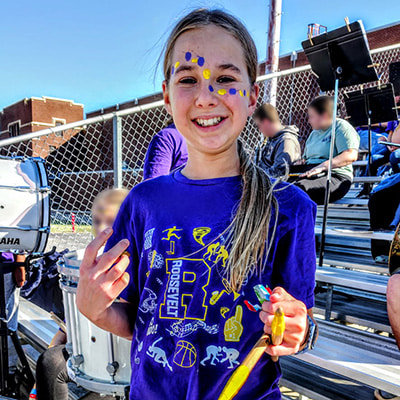
Now 13, Halle has always been petite, but it wasn’t until her permanent teeth came in during elementary school that she started to have difficulty opening her mouth well. “It was hard to eat,” Halle recalled. “I could only open my mouth so much, and I had to take really small bites.”
This began a six-year odyssey for Halle’s family to find out what was causing her jaw problems and decide on the best way to treat them.
First stop: Coffeyville, Kan.
The family dentist in their hometown of Coffeyville, Kan., was the first health care professional to notice that something wasn’t right with Halle’s mouth and jaw. In early 2020, he referred the family to a local orthodontist, who in turn suggested a jaw specialist in Oklahoma (Coffeyville is in southeast Kansas near the Oklahoma border).
And then ... Covid happened. Shutdowns delayed their appointment with the specialist for months. Finally, they were able to get the first round of tests and information about Halle’s jaw condition.
“It was pretty devastating,” remembered Halle’s mom, Robyn. “He took me back privately to his office and ran through a bunch of serious things it could be: cancer, juvenile arthritis — her jaw was completely fused on the left side.”
A diagnosis at last
The Oklahoma specialist consulted with colleagues all over the nation, including at Children’s Mercy, for input on Halle’s extremely rare situation. Finally, they arrived at a diagnosis: fibrous ankylosis of the jaw.
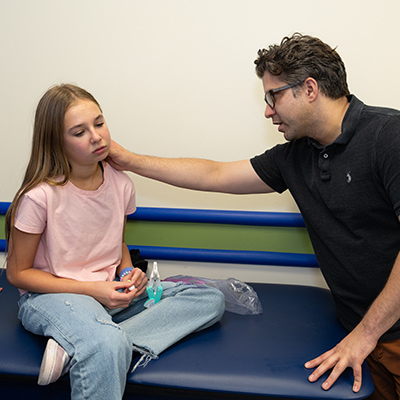
“Halle had a condition called temporomandibular joint (TMJ) ankylosis,” explained Adam Goodreau, MD, a plastic and reconstructive surgeon at Children’s Mercy. “Essentially, her jaw joint had fused to the base of her skull, preventing movement of the joint.”
Though they can’t be sure of the cause, a deep dive into Halle’s medical history unearthed a likely culprit: a life-threatening Group B strep meningitis infection when she was just a few days old. “When kids have an infection in their blood stream, sometimes the bacteria set up shop in a joint like the TMJ,” said Dr. Goodreau. “This is called septic arthritis, and it can be very destructive to a joint.”
Most cases of limited mouth opening in kids are caused by tight muscles around the mandible (jawbone). In those cases, minor surgery and physical therapy are usually enough to fix it, but Halle’s bone was completely fused together.
“Bony ankylosis is one of the most functionally limiting conditions we treat,” explained Dr. Goodreau. “Halle could only open her mouth about 8 or 9 millimeters — about the width of a pencil. For context, a normal opening at Halle’s age is upwards of 45 millimeters.” With such significant restriction of her jaw movement, her care team was concerned about not only eating, but also dental care, airway access and sleep apnea.
Now what?
Arriving at a diagnosis provided the family with some relief, but deciding on the best course of treatment was extremely stressful for Halle and her parents. They sought second (and third, and fourth) opinions from specialists across the Midwest to explore all the options for their daughter. The rare nature of her condition meant there was very little research or other families’ experiences available to guide them.
“There were different procedures that we could go through, so that made it challenging,” shared Scott, Halle’s dad. “Children’s Mercy really came to the rescue and helped us find the best path moving forward.”
Halle came to the JAWS (Jaw, Airway and Sleep) Clinic, which is part of the Plastic and Reconstructive Surgery Department at Children’s Mercy. The clinic brings together several different specialties, including plastic surgery, pulmonology and sleep, orthodontics and otolaryngology (ENT), to help children with a variety of problems with their jaw or facial shape.
The family immediately felt at home in the JAWS Clinic. “We finally met Dr. Goodreau, and we were just over-the-moon impressed with his sincerity and honesty about [Halle’s condition],” said Robyn. “He was amazing — so caring and sincere, just giving us his knowledge and factual info, no fear tactics.” As they weighed all the options, Robyn said, “We decided Dr. Goodreau was on point.”
Surgery success!
Surgery was finally scheduled in June of 2025, more than five years after Halle first began experiencing problems with her jaw.
Dr. Goodreau performed a procedure called resection of the ankylotic mass and costochondral rib graft reconstruction of the joint. He removed the fused bone in Halle’s jaw joint and replaced it with healthy rib bone and cartilage from her chest. “The cartilage cap is biologically active in growing children, which means it has the potential to grow with Halle as she matures,” he explained.
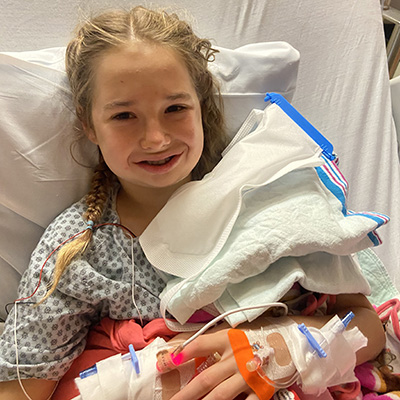
The nine-hour surgery was a success, and while recovery was rough for Halle, she powered through. After a two-week stint with her jaw wired shut, she was ready to begin rehab. “That’s when the real work started,” Robyn recalled. Halle had to do three sets of exercises every day with a tool that helped stretch her muscles, which she jokingly described as “a car jack for my mouth.”
Halle and her parents all appreciated Dr. Goodreau’s collaborative attitude and straightforward manner. He laid out different possible outcomes from the surgery and emphasized to Halle that it was her decision whether to move forward with it.
And she’s glad she did. “I feel good!” Halle shared. “I am sleeping better, and I definitely am excited that I can actually eat normally now.” Her jaw opening is now an impressive 55 millimeters — even higher than the expected range for this kind of procedure.
For his part, Dr. Goodreau gives much of the credit to Halle for her remarkable recovery. “Like so many kids with facial differences, Halle is incredibly resilient,” he said. “No matter how ‘perfect’ my surgery was, the outcome would not be as good as it is without lots of hard work from Halle and her team.”
“The best job in medicine”
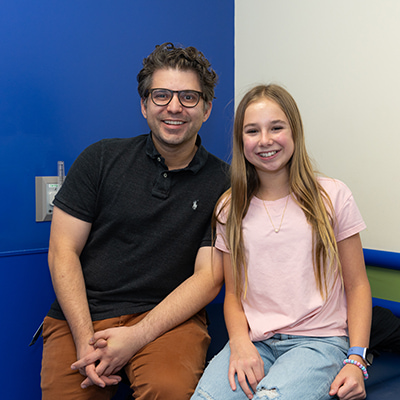
It’s likely that Halle will have another surgery when she is around 16 years old. But getting to follow patients like Halle through their entire journey is part of what makes Dr. Goodreau so passionate about craniofacial surgery. In fact, he considers it “the best job in medicine,” because he gets to collaborate with families and colleagues to address challenging conditions like these.
“Jaw problems, airway problems and sleep problems in children are deeply interconnected,” he explained. “Addressing them well requires a surgeon, an ENT airway specialist, a sleep medicine physician and an orthodontist working from a shared plan, not in separate silos. That’s the philosophy behind the JAWS clinic, and Halle's care is a good example of what that coordination looks like in practice.”
And for Halle? Another giant cheeseburger, coming right up.