
Abstract: Use of a Relational Agent Smart Phone App Aims to Improve Time in Range (TIR) for Youth with Type 1 Diabetes (T1D)
Sophie MacColl, Britaney Spartz, Emily L. DeWit, Brent Lockee, David D. Williams, Mitchell S. Barnes, Mark A. Clements
Background: Youth with T1D struggle to achieve blood glucose (BG) TIR targets. However, their inclination for technology makes a glucose self-management app an ideal intervention. We aimed to improve TIR using a relational agent smart phone app. The Happy Bob (HB) app uses Dexcom Continuous Glucose Monitor (CGM) data with personified nudges to gamify engagement for users in BG monitoring.
Method: We collaborated with HB developers to customize an app for youth ≥12 years old with T1D, who use Dexcom and a smartphone. We analyzed participants’ CGM data 28-days pre- and post-enrollment and required at least 7-days of wear time in both 28-day periods.
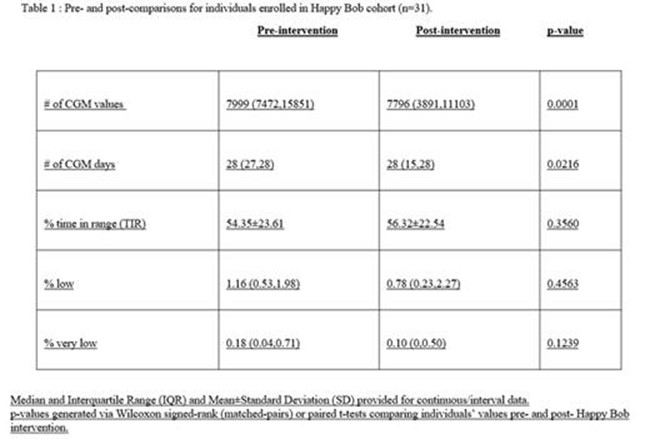
Results: For a cohort of N=31, average %TIR was (Mean±SD) 54.35±23.61 vs 56.32±22.54 pre- to post-intervention (p=0.3560), with % low and very low showing modest changes (Table 1). We further divided the cohort into 2 groups: those with a change in TIR <5.0% (n=22) vs those with a change ≥5.0% (n=9). Notably, the ≥5.0% group had lower %TIR values pre-intervention compared to the <5.0% group (33.56±11.63 to 62.86±22.00; p=0.0008) and showed an average increase in TIR of 15.1%.
Summary: In this pilot cohort, TIR values did not improve from pre- to post-intervention Future work should examine whether HB has a positive impact when bundled with additional interventions like remote patient monitoring.
Disclosure
S.Maccoll: None. B.Spartz: None. E.L.Dewit: None. B.Lockee: None. D.D.Williams: None. M.S.Barnes: None. M.A.Clements: Consultant; Glooko, Inc., Research Support; Dexcom, Inc., Abbott Diabetes.