
Abstract: Remedy to Diabetes Distress (R2D2)—Identify the Relationship between HbA1c, Socioeconomic Status (SES), and Diabetes Distress (DD)
Rhiannon Pomerantz, David D. Williams, Hung-Wen Yeh, Mark A. Clements, Susana R. Patton
Objective: DD among school-age children with Type 1 Diabetes (T1D) and their parents is associated with suboptimal glycemic control. We sought to determine if SES modulates the association between parent distress and child HbA1c.
Methods: Parents completed the Problem Areas in Diabetes-Child (P-PAID-C) and reported family demographics. We measured child HbA1c using a validated fingerstick homekit. We calculated a Hollingshead Score to quantify family SES. We developed a multivariable regression model with child HbA1c as the outcome and Hollingshead Tertiles (lowest = tertile 1) and P-PAID-C scores as predictors.
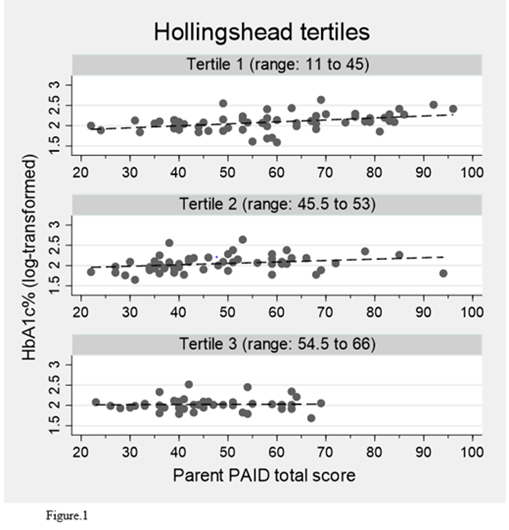
Results: The sample included N = 158 parent-child dyads,[M ± SD] child age 10.20±1.49 years, HbA1c 7.96±1.63%, 50% boys, 9.3% Black, 6.2% Hispanic; 88.8% of respondents were mothers. P-PAID-C score was 59.0±18.0. Simple correlations suggested higher child HbA1c associated with higher P-PAID-C scores and lower SES. Regression results showed P-PAID-C scores as the strongest predictor of child HbA1c even when including SES and an interaction variable. (Figure.1)
Conclusion: Child HbA1c increases as a function of parent DD, but family SES does not modify this association. Parent DD may represent a treatable, underscoring a need for research testing interventions to reduce parent DD levels.
Disclosure
R.Pomerantz: None. D.D.Williams: None. H.Yeh: None. M.A.Clements: Consultant; Glooko, Inc., Research Support; Dexcom, Inc., Abbott Diabetes. S.R.Patton: None.